
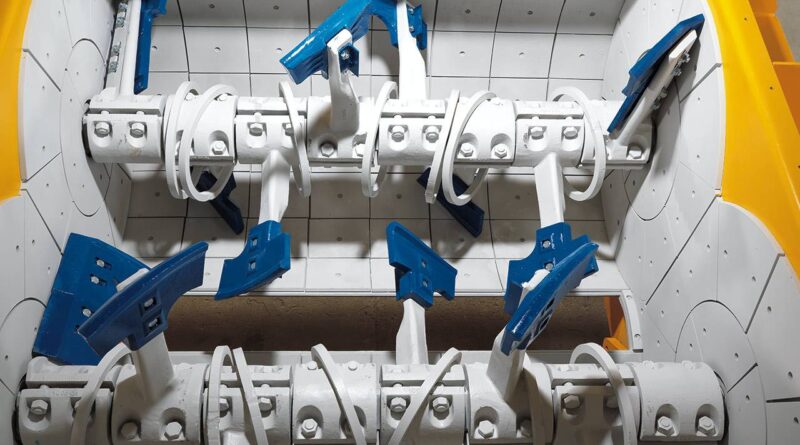
Twin Shaft Concrete Mixer: Working Principles, Benefits, and Applications
Consistent concrete mixing is essential for producing material with predictable strength, workability, and durability. Cement, aggregates, water, and admixtures must be distributed throughout the batch before the concrete moves to casting, pumping, or other construction processes. The mixing equipment plays an important role in achieving this consistency.
A Twin Shaft Concrete Mixer uses two horizontal shafts equipped with mixing tools to create intensive material movement inside the mixing chamber. The shafts typically rotate in opposite directions, causing the ingredients to circulate, collide, and redistribute throughout the batch.
What Is a Twin Shaft Concrete Mixer?
A twin shaft concrete mixer is an industrial mixing machine designed for producing concrete and other cement-based materials. It uses two parallel shafts fitted with paddles or mixing arms.
As the shafts rotate, the mixing tools move material through overlapping mixing zones. This creates strong circulation and mechanical interaction throughout the chamber.
The design is particularly suited to applications requiring high production rates and consistent batch quality.
How Does a Twin Shaft Mixer Work?
The mixing process begins when aggregates, cement, water, and other ingredients are introduced into the chamber.
The two shafts rotate and move the materials in different directions. This creates a combination of axial and radial movement that continuously redistributes the batch.
As ingredients pass through the mixing zones, cement paste and water are distributed around the aggregate particles. The cycle continues until the required level of uniformity is reached.
Key Working Principles
Counter-Rotating Shafts
The two shafts commonly rotate in opposite directions. Their interaction creates a strong mixing effect and encourages material movement throughout the chamber.
Overlapping Mixing Zones
The mixing tools are arranged so that their working areas overlap. This helps increase contact between the material and the mixing tools.
Intensive Material Circulation
Concrete is continuously lifted, pushed, folded, and redistributed. This movement helps reduce inactive areas inside the mixing chamber.
Controlled Discharge
After the mixing cycle, a discharge gate allows the finished concrete to leave the chamber and move to the next stage of production.
Benefits of Twin Shaft Concrete Mixers
High Mixing Efficiency
The twin-shaft design creates strong mechanical interaction, allowing large quantities of concrete to be mixed within relatively short cycles.
This can be beneficial for high-volume production environments.
Consistent Batch Uniformity
Continuous circulation helps distribute cement, aggregates, water, and admixtures throughout the mixture.
Consistent batch uniformity can support more predictable concrete properties.
High Production Capacity
Twin shaft mixers are often used where substantial output is required. Their design can support rapid mixing cycles while maintaining effective material movement.
Suitable for Various Concrete Types
Depending on the configuration, twin shaft mixers can process conventional concrete, low-slump mixtures, high-strength formulations, and other cement-based materials.
The mixer should be selected according to the specific formulation.
Applications of Twin Shaft Mixers
Twin shaft concrete mixers are commonly used in large-scale concrete production and industrial applications.
Typical uses include:
- Ready-mix concrete
- Precast concrete
- Road construction
- Bridge and infrastructure projects
- Concrete blocks
- Paving products
- Industrial concrete
- Large construction projects
The required mixer capacity depends on the production rate and batch size.
Use in Ready-Mix Concrete Production
Ready-mix plants often require high throughput and repeatable batch quality. Twin shaft mixers can provide strong mixing action while supporting relatively short production cycles.
The mixer can be integrated with automated aggregate weighing, cement dosing, water systems, and admixture equipment.
This allows the complete batching and mixing process to operate with limited manual intervention.
Use in Precast Concrete
Precast manufacturers need consistent concrete because products are repeatedly produced using molds or automated forming equipment.
A twin shaft mixer can help produce uniform batches suitable for precast components, paving products, blocks, and other manufactured concrete items.
The appropriate configuration depends on the required slump, aggregate characteristics, and production volume.
Factors Affecting Mixing Performance
Several factors influence how effectively a twin shaft mixer processes concrete.
Aggregate Size
Large or irregular aggregates affect material movement and mechanical load. The mixer should be designed to accommodate the largest aggregate size in the formulation.
Moisture Content
Changes in aggregate moisture can alter the effective water content of the concrete. Accurate moisture management is therefore important.
Batch Loading
Overloading the mixer can restrict material circulation and increase mechanical stress.
Mixing Time
The cycle should be long enough to achieve the desired uniformity. Excessive mixing can increase energy consumption and reduce production efficiency.
Tool Condition
Worn paddles or mixing arms can change the intended material-flow pattern and reduce mixing performance.
Choosing the Right Twin Shaft Mixer
Mixer selection should be based on both current production requirements and expected future demand.
Important factors include:
- Required batch capacity
- Hourly production target
- Concrete formulation
- Aggregate size
- Desired mixing cycle
- Motor power
- Discharge arrangement
- Automation requirements
- Wear resistance
- Maintenance needs
A mixer should be evaluated as part of the complete production system rather than as an isolated machine.
Consider Wear Resistance
Concrete aggregates can be highly abrasive. Continuous operation may cause wear on paddles, liners, shafts, seals, and other internal components.
Wear-resistant materials can help extend component life.
Before purchasing, ask about expected wear-part service life, inspection requirements, and replacement procedures.
Maintenance Requirements
Regular maintenance helps preserve mixing performance and reduce unexpected downtime.
Operators should inspect mixing tools, liners, bearings, seals, drive components, and discharge gates according to the manufacturer’s recommendations.
Keeping the mixing chamber clean can also help maintain consistent material movement.
Automation and Control Systems
Automated controls can improve production repeatability by managing ingredient dosing, water addition, mixing time, and discharge.
A twin shaft mixer can be integrated with weighing systems, aggregate bins, cement silos, conveyors, and other plant equipment.
The required automation level depends on plant size and production objectives.
Energy Efficiency
Twin shaft mixers use significant mechanical energy to create intensive material movement. Efficient operation depends on proper mixer sizing and optimized mixing cycles.
Operating with suitable batch loads and avoiding unnecessarily long cycles can help control energy consumption.
Energy efficiency should be evaluated together with throughput and mixing quality.
Conclusion
A twin shaft concrete mixer uses two counter-rotating shafts and multiple mixing tools to create intensive material circulation. This working principle supports efficient mixing and consistent distribution of cement, aggregates, water, and admixtures.
Twin shaft mixers are well suited to ready-mix plants, precast production, infrastructure projects, paving products, and other high-volume applications. When selecting equipment, manufacturers should consider capacity, formulation, aggregate size, cycle time, wear resistance, automation, maintenance, and total operating costs.