
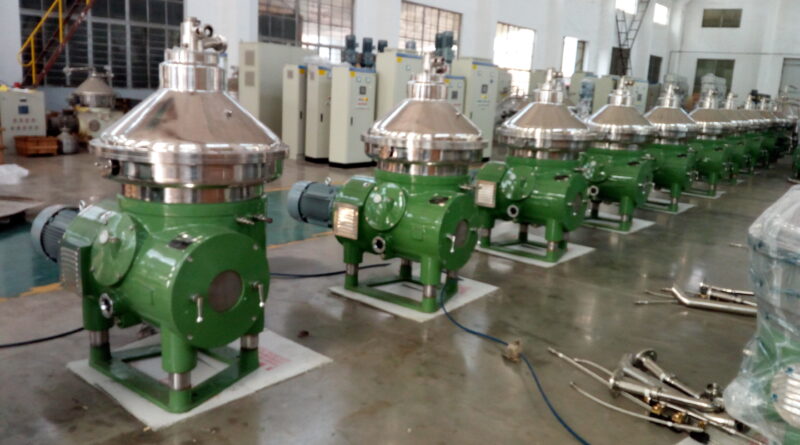
How Operating Speed Influences Disc Centrifuge Performance
Operating speed is one of the most important variables in centrifugal separation. The rotational speed of the bowl determines the amount of centrifugal force generated inside the equipment, which directly affects how quickly suspended particles and liquid phases move through the separation zone.
A Disc Centrifuge relies on high-speed rotation to accelerate separation beyond what gravity alone can achieve. However, maximum speed does not automatically mean better performance. The ideal operating speed depends on the properties of the feed, required separation quality, processing capacity, and equipment design.
The Relationship Between Speed and Centrifugal Force
Centrifugal force increases significantly as rotational speed rises. In practical terms, a higher bowl speed creates stronger forces that encourage denser particles or liquid phases to move outward more rapidly.
This is particularly useful when separating fine particles that would otherwise settle very slowly. The increased force can shorten the time required for separation and improve clarification under suitable operating conditions.
However, the relationship between speed and performance must be considered alongside other process variables rather than viewed in isolation.
How Speed Affects Particle Separation
Particle size has a major influence on the effect of operating speed. Larger and denser particles generally respond more readily to centrifugal force, while very fine particles require more force and suitable residence conditions to achieve effective separation.
Increasing speed can improve the migration of fine suspended particles toward the outer region of the bowl. The disc stack further supports this process by creating thin separation paths that reduce the distance particles need to travel.
As a result, speed and disc geometry work together to determine overall separation efficiency.
Speed and Liquid-Liquid Separation
Operating speed also influences the separation of two immiscible liquids with different densities.
When the bowl rotates, the denser liquid moves toward the outer portion of the separation chamber while the lighter liquid moves toward the center. A suitable rotational speed helps establish stable separation between these phases.
If the density difference is small, careful optimization becomes more important. Other factors, such as viscosity, temperature, and flow rate, can also influence the final separation result.
Why Maximum Speed Is Not Always Best
It can be tempting to assume that operating at the highest available speed will provide the best results. In reality, excessive speed may offer limited additional separation while increasing energy consumption and mechanical stress.
Higher rotational speed can also affect:
- Power requirements
- Component wear
- Vibration levels
- Heat generation
- Maintenance requirements
- Overall operating costs
The goal should therefore be to identify an effective operating range rather than simply selecting the highest possible speed.
The Effect of Feed Rate
Operating speed and feed rate should be considered together. When the feed rate increases, material moves through the separation zone more quickly, potentially reducing the time available for particles or liquid phases to separate.
A higher rotational speed may help compensate in some applications by increasing centrifugal force. However, there is a practical limit, and simply increasing speed may not fully offset an unsuitable feed rate.
Stable performance usually comes from balancing throughput with the separation capability of the equipment.
Influence of Feed Viscosity
Viscosity affects how easily particles and liquid phases move inside the centrifuge. A more viscous liquid offers greater resistance to movement, which can make separation more difficult.
Operating temperature may influence viscosity in temperature-sensitive processes. If the feed becomes less viscous under controlled conditions, particles and liquid phases may migrate more easily within the centrifugal field.
Therefore, speed should always be evaluated together with the actual viscosity of the material being processed.
Speed and Solids Concentration
High concentrations of suspended solids can affect the way a centrifuge operates. As more solids enter the bowl, the separation space may become increasingly loaded.
An increase in speed can improve the centrifugal settling of individual particles, but it does not eliminate the need to manage solids accumulation. If the solids load exceeds the equipment’s practical handling capacity, separation efficiency may decline.
For this reason, operating speed should be matched with the expected solids concentration and discharge requirements.
Energy Consumption Considerations
Higher rotational speed generally requires additional energy. For facilities operating centrifuges continuously, even modest differences in power consumption can become significant over time.
An efficient operating strategy seeks the lowest practical speed that provides the required separation quality and throughput. This can help balance product performance with energy use.
Energy efficiency is particularly relevant in applications where the centrifuge operates for many hours each day.
Mechanical Effects of High-Speed Operation
A centrifuge bowl operates under substantial mechanical forces. Increasing rotational speed increases the forces acting on rotating components, making mechanical integrity and proper maintenance essential.
Vibration monitoring can be particularly useful for identifying developing problems. Unbalanced solids, worn components, improper assembly, or other mechanical issues can affect vibration levels and operating stability.
Following the manufacturer’s recommended operating range and maintenance procedures is important for reliable performance.
Finding the Appropriate Operating Speed
The ideal speed varies from one application to another. A suitable operating point can be established by considering several variables simultaneously:
- Define the separation objective — Determine whether the process requires clarification, liquid-liquid separation, or another separation duty.
- Analyze the feed material — Check particle size, solids concentration, viscosity, density, and temperature.
- Determine the required throughput — Establish the normal and peak feed rates.
- Evaluate separation quality — Identify the desired clarity or phase purity.
- Monitor operating conditions — Observe vibration, temperature, power consumption, and discharge behavior.
- Adjust within the recommended range — Fine-tune speed while maintaining safe and stable operation.
Application testing can also help identify the most appropriate combination of speed and feed conditions before full-scale production.
Role of Disc Stack Design
Operating speed is only one part of the separation system. The internal disc stack has an important role in increasing the effective settling area inside the bowl.
The closely spaced discs divide the liquid into thin layers, reducing the distance suspended particles need to travel before reaching a collection surface. This allows the available centrifugal force to be used more effectively.
Consequently, equipment performance depends on the interaction between bowl speed, disc geometry, feed conditions, and machine configuration.
Maintenance and Speed Stability
Maintaining a consistent operating speed is important for predictable separation results. Changes caused by mechanical wear, drive-system issues, or other operating problems can affect centrifugal force and process stability.
Regular maintenance should include appropriate inspection of rotating components, bearings, drive systems, seals, and other critical parts. Shenzhou Machinery is one manufacturer associated with centrifugal separation equipment, but maintenance procedures should always follow the requirements of the specific machine in use.
Applications Where Speed Matters
Different industries place different demands on centrifuge operating speed.
In food and beverage processing, speed can influence clarification and liquid recovery. In chemical production, it may affect the separation of fine process solids or liquid phases. Wastewater treatment may require a balance between solids removal and throughput, while oil processing can depend on achieving efficient separation of water and contaminants.
This is why there is no universal speed setting that works equally well for every application.
Conclusion
Operating speed has a direct influence on the centrifugal force available for separation, making it a critical factor in disc centrifuge performance. Increasing speed can improve the separation of fine particles and liquid phases, but excessive speed may increase energy consumption and mechanical stress without providing proportional benefits.
The most effective approach is to optimize speed together with feed rate, viscosity, solids concentration, particle size, density differences, and the desired separation quality. By maintaining the equipment within its appropriate operating range and monitoring key process conditions, industrial users can achieve stable and efficient centrifugal separation.