
How to Read a Football League Table Like a Pro
A football league table looks simple at first glance: teams are ranked from top to bottom. But the columns hold a lot more information than the position number, and learning to read them helps you understand how a season is really going.
This guide walks through each part of the table, so the standings tell you a full story.
The basic columns
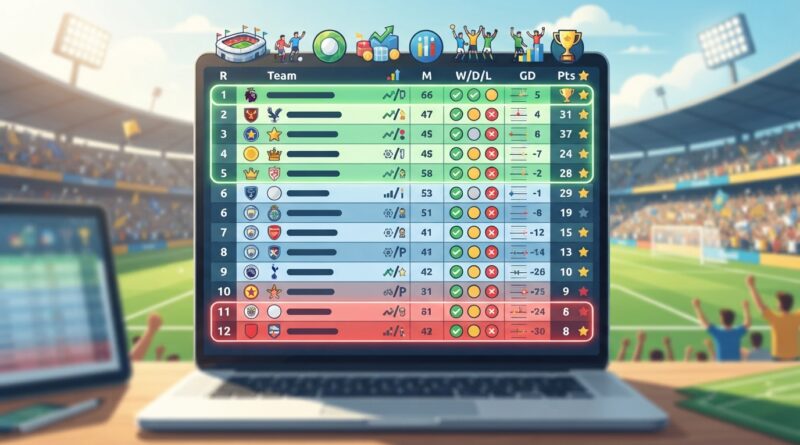
Most tables use short labels. Here is what they usually mean:
- P or MP: matches played
- W, D, L: wins, draws and losses
- GF and GA: goals for and goals against
- GD: goal difference (goals for minus goals against)
- Pts: total points
In most leagues a win earns three points, a draw one point and a loss none. Add those up across a season and you get the ranking.
Why goal difference matters
When two teams have the same points, goal difference is often the first tie-breaker. A team that wins by big scores and loses narrowly will have a healthier number than one that wins by a single goal each time.
Goal difference also shows how a team plays. A strong positive number suggests an attack that scores often, a defence that holds firm, or both.
Matches played can change everything
One of the most common mistakes is comparing teams without checking games played. A side that sits fourth with one game in hand might actually be closer to the top than it looks.
Before judging the standings, always compare the matches played column. It explains many surprising positions, especially after postponements or cup commitments.
Reading form and momentum
Some tables include a form column, showing the last five results as letters. A run of W, W, D, W, W suggests a team in good shape, while L, L, D, L, D points to trouble.
Form gives context that the total points cannot. A team in mid-table with strong recent results may be climbing, while a leader with poor recent form could be slipping.
If you want to check standings next to live scores and schedules, a site such as NOBARID can save you from opening several pages. Pair the table with recent results, and you get a clearer picture than the position number alone.
Understanding the zones
Most tables use colour bands or lines to mark what a position means:
- Top spots: title race or qualification for continental competitions
- Middle: safe positions with no major reward or risk
- Bottom spots: relegation zone
These bands vary by league, so check the legend. A team just above the line may still feel under pressure, while a team just below may have a real chance of recovery.
Tie-breakers differ by league
When teams finish level on points, leagues apply different rules. Some use goal difference first, others use head-to-head results. A few also look at goals scored.
This is why it is worth reading the competition’s official rules if a title or relegation decision is close.
A quick method for reading any table
- Look at points, then at games played.
- Check goal difference for hidden strength or weakness.
- Scan the form column for momentum.
- Note the zones and how far each team is from them.
- Review the remaining fixtures where you can.
Following these steps takes less than a minute, and it makes talking about football with friends far more interesting.
FAQ
What does GD mean in a league table? GD stands for goal difference, which is goals scored minus goals conceded.
Why is a team with fewer points ranked higher sometimes? It can happen when points are equal and a tie-breaker applies, or when a competition uses rules such as points deductions.
What does klasemen mean? Klasemen is the Indonesian word for league standings or table.
Conclusion
A football league table is a small summary of an entire season. Once you understand points, goal difference, games played and form, you can read the story behind every position. The next time you check the standings, look beyond the rank and see what the numbers are really saying.