
How to Choose Inflatable Games for Sale for Your Entertainment Business
Choosing the right equipment is an important decision for any entertainment business. Whether you operate an event rental company, family entertainment center, amusement venue, or party planning service, investing in suitable inflatable attractions can help you create engaging experiences for your customers. However, with so many designs, sizes, and features available, finding the right products requires careful planning.
When exploring Inflatable Games for Sale, business owners should consider more than the initial purchase price. Factors such as target audience, material quality, safety features, installation requirements, maintenance needs, and potential revenue all influence the long-term value of an investment.
This guide explains how to evaluate inflatable games and select products that align with your business goals, customer expectations, and available budget.
1. Identify Your Entertainment Business Model
Before comparing products, determine how the inflatable games will be used. Different entertainment businesses have different operational requirements, and the right attraction for one business may not suit another.
Event Rental Businesses
Rental companies typically transport equipment between different venues, including birthday parties, school events, festivals, and corporate gatherings. For these businesses, portability, setup time, storage requirements, and durability are particularly important.
Inflatable games that are easy to transport and install can help simplify daily operations. You should also consider whether the product can fit into the vehicles available for transportation and whether your team can handle setup and dismantling efficiently.
Family Entertainment Centers
Family entertainment centers often need attractions that can withstand frequent use. Products should match the venue’s available floor space, customer demographics, and operating schedule.
Interactive games, inflatable obstacle courses, and themed play structures can provide variety for visitors. Before purchasing, evaluate the attraction’s capacity, supervision requirements, cleaning procedures, and compatibility with other activities in your facility.
Festival and Event Organizers
Festivals and public events often attract large groups of visitors within a limited period. Organizers may benefit from visually appealing attractions that accommodate suitable participant flows and offer engaging activities for different age groups.
For outdoor events, weather conditions, anchoring systems, ground surfaces, and access to electricity should be included in the planning process.
2. Choose Inflatable Games That Match Your Target Audience
Understanding your customers is essential when selecting inflatable equipment. Age, interests, physical abilities, and group size can influence which attractions provide the best experience.
Inflatable Games for Young Children
Younger children often enjoy colorful bounce houses, small inflatable slides, and themed play areas. These attractions should have age-appropriate designs, suitable entry points, and clearly defined operating limits.
Check the manufacturer’s recommended age range, participant capacity, and supervision guidelines before making a purchase.
Games for Teenagers and Adults
Older participants may prefer more challenging and competitive activities. Inflatable obstacle courses, jousting arenas, interactive sports games, and team challenges can create exciting experiences for this audience.
When comparing these options, examine the game’s complexity, space requirements, and suitability for the expected participants.
Family-Friendly Attractions
If your business serves mixed-age groups, consider offering several types of inflatable games rather than relying on a single attraction. A combination of simple play structures and interactive challenges may help accommodate different preferences.
However, different age groups should only share an attraction when the manufacturer’s instructions and operating rules explicitly allow it.
3. Compare Different Types of Inflatable Games
The type of game you choose affects customer appeal, installation requirements, and potential business applications.
Bounce Houses
Bounce houses are popular for birthday parties, family celebrations, school functions, and community events. Their straightforward play concept makes them familiar to many customers.
When selecting a bounce house for commercial use, examine its dimensions, material specifications, access points, anchoring requirements, and recommended participant limits.
Inflatable Obstacle Courses
Obstacle courses introduce climbing, crawling, running, and other physical challenges. They may be suitable for corporate events, school activities, festivals, and competitive entertainment programs.
Because these structures can require considerable space, measure the installation area carefully. Allow room for safe entry and exit, supervision, and any additional clearance specified by the manufacturer.
Inflatable Sports Games
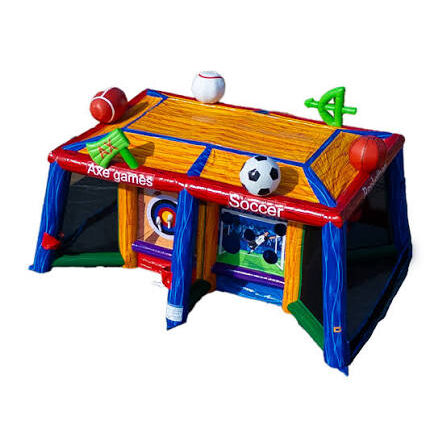
Inflatable basketball, soccer, football, and other sports-themed games can appeal to participants who enjoy friendly competition. They are useful for sports festivals, promotional events, school functions, and corporate gatherings.
Consider whether the game supports individual or team participation, how scores are tracked, and whether the equipment can be used by your intended audience.
Interactive Inflatable Games
Interactive attractions may feature targets, reaction challenges, timed activities, or head-to-head competitions. They can encourage repeated participation and provide entertainment for both players and spectators.
Before purchasing, ask about the equipment’s operating procedure, included accessories, replacement components, and maintenance requirements.
4. Evaluate Material Quality and Construction
Material quality plays a major role in the durability and performance of commercial inflatable games. Products used frequently or transported between locations may experience greater wear than attractions used occasionally at home.
Examine the Materials
Ask the manufacturer which materials are used and whether their specifications are suitable for your intended application. Commercial inflatable games may use PVC-coated fabrics or other specialized materials, depending on the product design.
Avoid evaluating quality based only on material names. Thickness, coating, reinforcement, manufacturing methods, and the overall design also influence durability.
Check Seams and Reinforcement
Seams, corners, attachment points, and areas exposed to repeated stress deserve particular attention. Ask whether the manufacturer uses reinforced construction in areas that experience frequent movement or contact.
If possible, request detailed product photographs, technical specifications, and information about quality-control procedures.
Review Repair and Replacement Options
Even well-maintained equipment may eventually require repairs. Before buying, find out whether repair kits, replacement components, and technical support are available.
Access to suitable parts and repair guidance can help reduce downtime and protect your investment over time.
5. Prioritize Safety Features and Compliance
Safety should be a central part of every purchasing decision, particularly when inflatable games will be used by the public.
Confirm Anchoring and Stability Requirements
Inflatable attractions must be installed according to the manufacturer’s instructions. Depending on the product and location, this may involve approved stakes, ballast, or other specified anchoring methods.
Ask the supplier for clear installation guidance and details about the required ground conditions. Outdoor installations should also account for wind limits and procedures for stopping operation when conditions become unsafe.
Review Participant Capacity
Each attraction should have clearly defined operating limits. Confirm the maximum number of participants, permitted user characteristics, supervision requirements, and any restrictions on simultaneous use.
Staff should understand how to manage queues, prevent overcrowding, and respond to changing operating conditions.
Ask About Safety Documentation
Depending on the product, intended use, and destination market, relevant documentation may include inspection records, technical manuals, material information, and evidence of compliance with applicable standards.
Do not assume that every inflatable game meets the same requirements. Ask the manufacturer which standards apply and verify the documentation relevant to your jurisdiction.
6. Calculate the Total Cost of Ownership
The lowest purchase price does not necessarily represent the best value. A proper budget should include the costs of acquiring, transporting, operating, maintaining, and storing the equipment.
Consider the following expenses:
- Purchase price: The initial cost of the inflatable game and any optional features.
- Shipping and import charges: Freight, customs duties, taxes, and other applicable fees.
- Installation equipment: Blowers, anchoring systems, electrical accessories, and other required components.
- Labor: Setup, dismantling, supervision, transportation, and cleaning.
- Maintenance: Repairs, inspections, cleaning materials, and replacement parts.
- Storage: Space, protective covers, and suitable storage conditions.
- Insurance and compliance: Applicable business insurance, inspections, permits, or certification costs.
Comparing these expenses across suppliers can provide a more realistic picture of the investment.
Estimate Potential Revenue
For rental businesses, estimate how much the attraction could earn per booking and how frequently it may be rented. For permanent venues, consider whether the attraction could contribute to admission sales, activity packages, or special events.
For example, if an inflatable game costs $3,000 and generates $150 in contribution per rental after direct booking expenses, it would require 20 rentals to recover that initial equipment cost.
This is a simplified illustration. Actual results depend on demand, fixed overhead, maintenance, taxes, downtime, and other expenses. A conservative estimate is more useful than assuming the equipment will be rented continuously.
7. Check Setup, Transportation, and Storage Requirements
Practical operating considerations can affect the efficiency of your business just as much as product quality.
Measure the Available Space
Before ordering, measure the intended installation area and confirm the product’s inflated dimensions. Account for ceiling height for indoor venues, clearance around the structure, entrances and exits, and any additional safety zones specified by the manufacturer.
For mobile businesses, compare the packed dimensions with your vehicle’s available cargo space.
Understand Setup Procedures
Ask the supplier how many people are typically required for installation and dismantling, how long setup takes, and which tools or accessories are needed.
Request clear instructions covering blower placement, anchoring, inflation, inspection, and shutdown procedures. These details can help you plan staffing and event schedules more accurately.
Plan for Proper Storage
Inflatable games should be cleaned, dried as directed, and packed according to the manufacturer’s instructions before storage. Moisture, excessive heat, sharp objects, and unsuitable storage conditions can contribute to premature deterioration.
Confirm the packed weight and dimensions before purchasing, especially if your business has limited storage space.
8. Compare Manufacturers and Suppliers Carefully
A suitable supplier should provide more than an attractive product catalog. Reliable communication, accurate specifications, after-sales support, and clear commercial terms can make a substantial difference.
Review Product Information
Look for detailed dimensions, material specifications, weight, electrical requirements, capacity limits, included accessories, and operating instructions.
If important information is missing, request clarification before placing an order. Avoid relying on product photographs alone to determine whether an attraction meets your requirements.
Ask About Customization
Some manufacturers offer customized colors, graphics, themes, and dimensions. These options can help businesses create branded attractions for promotional campaigns or distinctive entertainment experiences.
Before requesting customization, clarify minimum order quantities, design approval procedures, production timelines, and any additional costs.
Evaluate Warranty and After-Sales Support
Ask what the warranty covers, how long it lasts, and which conditions may exclude coverage. You should also understand the process for reporting defects, obtaining replacement parts, and arranging technical assistance.
A clearly documented support process can be particularly valuable for businesses that depend on their equipment for scheduled events.
Request References or Evidence of Experience
Where possible, review verified customer feedback, examples of completed projects, and evidence of the supplier’s experience with similar commercial products.
For large purchases, consider requesting a sample, a factory inspection, or an independent assessment where practical. The appropriate level of verification depends on the order value and the complexity of the equipment.
9. Consider Customization and Branding Opportunities
Customized inflatable games can help entertainment businesses stand out in competitive markets. Branded colors, logos, and themed designs may be useful for corporate events, promotional campaigns, sports activities, and permanent entertainment venues.
However, customization should support a clear business objective rather than simply increase the product’s visual complexity.
Before approving a custom design, confirm that it preserves appropriate access points, visibility, safe movement, and the structural requirements of the original product. Ask the manufacturer to explain how the proposed changes affect price, lead time, cleaning, maintenance, and replacement options.
For rental companies, flexible themes may be more practical than designs tied to a single customer or event.
10. Create a Balanced Equipment Portfolio
Businesses do not always need to purchase several large attractions at once. A carefully selected portfolio can help operators test demand while managing initial investment.
For example, a new rental company might begin with a versatile bounce house and a compact interactive game. After reviewing booking patterns and customer feedback, it could add a larger obstacle course or sports-themed attraction.
Established entertainment centers may use a different approach, adding games that complement their existing facilities or fill gaps in their current offering.
When planning a portfolio, consider:
- The most frequently requested activities among your customers.
- The age groups and event types your business serves.
- Available transportation, storage, and installation capacity.
- Seasonal changes in demand.
- The maintenance requirements of each attraction.
- Opportunities to combine compatible games into rental packages.
This approach can help prevent unnecessary purchases and support more informed expansion decisions.
Common Mistakes to Avoid When Buying Inflatable Games
Even experienced business owners can overlook important details when comparing inflatable products. Avoiding common purchasing mistakes can reduce operational problems and unexpected costs.
Choosing solely by price: A low-cost product may not offer the construction quality, documentation, or support needed for frequent commercial use.
Ignoring space requirements: An attraction that does not fit the intended venue may be difficult or impossible to operate safely.
Overlooking operating expenses: Electricity, labor, shipping, cleaning, repairs, and storage all contribute to the real cost of ownership.
Assuming every product is suitable for commercial use: Confirm that the equipment is designed for your intended frequency of use and business environment.
Failing to verify supplier claims: Request relevant specifications and documentation instead of relying on broad marketing statements.
Neglecting staff training: Employees should understand installation, inspection, participant management, emergency procedures, and the manufacturer’s operating instructions.
Conclusion
Choosing the right inflatable games for your entertainment business requires a balance of customer appeal, product quality, safety, operating costs, and long-term business objectives. By identifying your target audience, comparing different game types, evaluating construction, and reviewing supplier support, you can make a more informed purchasing decision.
When exploring Inflatable Games for Sale, focus on products that suit your business model, available space, and expected usage. Consider the full cost of ownership rather than the initial price alone, and verify all relevant technical specifications and safety requirements before committing to a purchase.
A thoughtful selection process can help your business build a suitable entertainment offering, manage operating expenses, and provide enjoyable experiences for customers over the long term.